Showing posts with label freedom. Show all posts

Tuesday, February 28, 2017

Software Freedom needs your help.

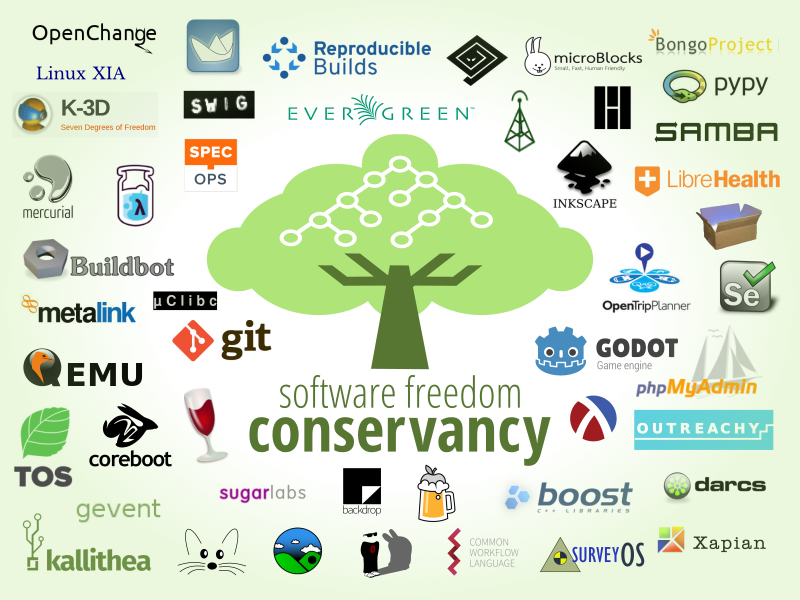
Conservancy is continuing its shift towards being a Supporter-driven organization so we can focus on critical free software issues. Support our great member projects, stand up for the GPL, and make your voice heard in support of free software. We're counting on you.

Software is critical to all of our infrastructure and as a society, we are deeply reliant on the software we use. Making sure our software is free and open assures that tomorrow we can still use those solutions we invest in today. Software freedom is fundamental — we need it in order to effectively solve our problems in the long term. While the world today is powered increasingly by free software, many people don't realize is how much support is needed to keep all of these projects free and open. The work that we do every day ensures the success and the continued freedom of the projects. Our developers dedicate themselves to improving our member projects, and we enable them to do that. This includes projects like Git, Samba, Wine, BusyBox, QEMU, Inkscape, Selenium, and dozens more.
We are asking for you to . Last year, over 1,000 of you became annual Supporters, allowing us to continue our basic operations. We still need 2,500 (total) annual Supporters to continue our full range of operations through 2017. If you don't become a Supporter now, we will be forced to reduce our program activities going forward.


Friday, January 15, 2016

Software Freedom needs your help.


The world today is powered increasingly by Free Software. But what many people don't realize is how much support is needed to keep all of these projects free and open. The work that we do every day ensures the success and the continued freedom of the projects that the developers of our member projects dedicate themselves to. Projects like Git, Samba, Wine, BusyBox, QEMU, Inkscape, Selenium, and dozens more.

We are asking for you to  but this is more than our usual annual fundraising appeal. As described in more detail below, after the events of 2015, we must substantially increase our individual support to be able to continue defending software freedom for our member projects and the entire free and open source software community. We need at least 750 of you to become annual Supporters just to continue our basic community services. We need 2,500 of you to become annual Supporters now to continue our work enforcing copyleft licenses. If you don't become a Supporter now, we will be forced to radically restructure and wind down a substantial portion of our operations.

Wednesday, March 11, 2015

Build Your Information System For Free Using These Tools

Information system is a very essential and fundamental component in every business and organization. Generally, it is a set of network of hardware and software which users use to collect, manage, create and distribute their data.
It consists on the information and communication technology utilized by organizations for supporting their business processes. As it is important to create and have the right information system it is also important to find the right tools to use for making your own information system.
But what do you think if you can build your information system for free? Yes for free, it is not a jock. Follow us and you will understand that this can be a reality. We will describe the different tools one by one giving the benefits of using every one of them just for making your information system.

http://www.unixmen.com/build-information-system-free-using-tools/

Tuesday, November 12, 2013

How to write your book using Linux, making Docker work on Fedora, and more


WEEKLY NEWS

FROM THE ARCHIVES

OPEN SOURCE EVENTS

Here's what's coming up in November:

  • Forum PHP 2013 is billing itself as "the most important international talks cycle dedicated to the language and its ecosystem in France." The forum is Nov. 21-22 in Montrouge, Paris, France.

  • Open Source Licensing in an Agile Environment is a webinar scheduled 9 a.m. EDT on Nov. 20.

  • Check out the events calendar to see other upcoming open source events and submit your own!


Docker is generating a lot of interest in the Fedora community. Red Hat principle software engineer Alexander Larsson
explains the steps being taken to make Docker work on Fedora.

An open source disruption of education can be truly powerful and transformative in the world, but for that to happen, computer science educator Matt Jadud says this must happen first.

"American Idol" has perfected participation. Red Hat CEO Jim Whitehurst outlines what open source projects and communities can learn from American Idol's success


Browse the library of free open source-related eBooks from Opensource.com.

ENTERPRISERS PROJECT

Join the open source dialogue about the future of CIOs.


"Chief Lateral Thinking Officer." CIOs are responsible for more than ever. So is it time for a new job title? Here are a few suggestions from The Enterprisers Project. Check them out and share your C?O.


Wednesday, October 9, 2013

U.S. Ranks Fourth in Internet Freedom as Surveillance Grows Worldwide

Network World (10/04/13) Colin Neagle 

Although U.S. Internet freedom has decreased over the past year due to surveillance, the United States still ranks fourth in a recent Freedom House study of 60 countries. The study measured obstacles to accessing information online, content limitations, and violations of user rights. In addition, the study cites issues such as government blocking of specific Internet content, surveillance measures, and actions taken against online dissidents to governing or religious bodies. Iceland claimed the top spot on the list as the most free nation on the Internet, followed by Estonia, Germany, and the United States. The remaining top 10 included Australia, France, Japan, Hungary, Italy, and the United Kingdom. Surveillance has grown more advanced and pervasive in 35 out of the 60 countries examined, according to the study. The most restrictive countries were Iran, China, and Cuba. However, the study notes 16 countries, including Morocco, Burma, and Tunisia, that have increased Internet freedom. Meanwhile, Freedom House says India showed the biggest drop in Internet freedom over the past year. Freedom House said the drop was due to "deliberate interruptions of mobile and Internet service to limit unrest, excessive blocks on content during rioting in northeastern states, and an uptick in the filing of criminal charges against ordinary users for posts on social-media sites."

Saturday, July 13, 2013

Cancel Netflix if you value freedom

Dear Pascal,
For the last few months, we've been raising an outcry against Encrypted Media Extensions (EME), a plan by Netflix and a block of other media and software companies to squeeze support for Digital Restrictions Management (DRM) into the HTML standard, the core language of the Worldwide Web. The HTML standard is set by the World Wide Web Consortium (W3C), which this block of corporations has been heavily lobbying as of late.
The proposed adoption of EME is disturbing for what it says about the way decisions are made relative to the Web, but what does it mean for you as a free software user?
DRM and free software don't mix. All DRM software relies on keeping secrets, like decryption algorithms, from the user, so that users cannot design their own method to modify it. The secrets are stored on users' own computers in places users cannot access or even read. This practice inherently tramples Freedom 1 of the Free Software Definition: the freedom to study how a program works and change it so it does your computing as you wish.
This means that each time a part of the Web starts requiring DRM software to decrypt it, it becomes inaccessible to free software. And if influential companies like Netflix, Google and Microsoft succeed at jamming DRM into the HTML standard, there will be even more pressure than there already is for people distributing media to encumber it with DRM. We'll see an explosion of DRM on the Web -- a growing dark zone inaccessible to free software users. This threatens to happen at a time when the state of free software-friendly media on the Web was starting to improve, with the increasing quality of free video codecs and the decline of Flash accompanied by the rise of the HTML5 video tag.
Netflix's lobbying in the W3C is paid for by subscription fees, so we're asking you to help pull that money out from under them by boycotting their services. If you have an account, use this link to cancel it. Whether you're canceling an account or not, you can help the boycott build momentum by spreading the word with the hashtag #CancelNetflix.[1]
This is about more than just movies and music on the Web. The adoption of EME would represent an enclosure of the free Web and the incremental erosion of users' freedom. What's at stake is not only whether you will be able to save and remix videos or music, but also whether your web browser and operating system can be free and continue to experience the same Web as everyone else.
Microsoft has already modified Internet Explorer to start supporting EME for media streaming. Simultaneously, Netflix has begun publicly promoting Internet Explorer, revealing a two-pronged strategy of pushing proprietary browsers while attacking Web standards in the W3C. If they succeed at passing EME, pressure will be put on browsers (including the free browsers we use to surf the Web) to support this corrupt new standard. Showing opposition to EME now is a good way to demonstrate that, if it comes to this, we will stand with the free browsers in favor of their ideals.

Standing up to Netflix at the W3C

Mark Watson, an engineer from Netflix, is spearheading the effort to pass EME in the W3C, using his company's economic power to influence the consortium. The FSF and our allies have been fighting back by organizing free software users and the anti-DRM movement against the EME proposal. More than 22,000 people signed our petition demanding W3C drop EME, which we delivered in person to the W3C in May.
We have accounts that we've gotten through to many of the people that are involved with the W3C -- people who care about the Web understand that EME is a terrible idea. But the W3C's leadership, including its CEO Jeff Jaffe, are supportive of Netflix and its block. This became apparent when our friends at the Electronic Frontier Foundation filed a formal objection to EME within the W3C's official process, and Jaffe reacted by trying to shove it aside and steam ahead with ratifying the proposal.
This is the time to push hard on the W3C and Netflix, and demonstrate that we refuse to choose between accessing the Internet and having freedom as software users. Please join us: revoke your support for Netflix now and spread the word. Once you've canceled, how about donating those subscription funds to the Free Software Foundation or another group that is fighting on your behalf? We will use those dollars to amplify the impact of your cancellation.
Sincerely,
Zak Rogoff, Campaigns Manager
[1] We encourage users to do their microblogging with Web sites that do not include nonfree JavaScript, like identi.ca and other instances of pump.io. If you prefer Twitter, you can use the mobile version of the Twitter site which works with JavaScript turned off, even on a desktop computer.
This post can be viewed online at https://www.fsf.org/blogs/community/cancel-netflix-if-you-value-freedom

Thursday, November 22, 2012

Internet Freedom Remains U.S. Priority at U.N. Conference


IDG News Service (11/18/12) Grant Gross

The U.S. delegation to the U.N. International Telecommunication Union's (ITU's) upcoming World Conference on International Telecommunications (WCIT) will advocate for free speech online and oppose any broad new Internet regulations, says delegation head Terry Kramer.  The delegation is worried that some nations will lobby for telecom-style termination fees for Web traffic in order to raise funds for broadband implementation, while some countries might call for Internet censorship for cybersecurity reasons.  Kramer says the United States will oppose any attempt to impose online regulation.  Meanwhile, ITU's Gary Fowlie says the WCIT's regulations should be extended to support a "global information society."  Fowlie also says WCIT should investigate ways to ensure universal Internet affordability and accessibility.  However, he notes that Internet censorship efforts would run afoul of the U.N.'s Universal Declaration of Human Rights, which upholds freedom of expression "through any media and regardless of frontiers."  Syracuse University professor Milton Mueller advocates ITU jettisoning international telecom regulations, with such rules best left to private companies and civil society.
http://www.pcworld.com/article/2014714/internet-freedom-remains-us-priority-at-un-conference.html

Wednesday, March 28, 2012

Document Freedom Day

Celebrating information accessibility and raising awareness of Open Standards

Open Standards and why they matter

Open Standards are essential for interoperability and freedom of choice based on the merits of different software applications. They provide freedom from data lock-in and the subsequent vendor lock-in. This makes Open Standards essential for governments, companies, organizations and individual users of information technology.

Visible effects of Open Standards are that you can:
    • Choose any operating system or application and still be able to read and edit all your old documents.
    • Collaborate with others regardless of which software they are using.
    • Use any software of your choice to interact with businesses, the government, and others.

    Definition

    For the purpose of Document Freedom Day, the working understanding of "Open Standards" is that the standard be:

    • subject to full public assessment and use without constraints in a manner equally available to all parties;
    • without any components or extensions that have dependencies on formats or protocols that do not meet the definition of an Open Standard themselves;
    • free from legal or technical clauses that limit its utilization by any party or in any business model;
    • managed and further developed independently of any single vendor in a process open to the equal participation of competitors and third parties;
    • available in multiple complete implementations by competing vendors, or as a complete implementation equally available to all parties.
      What can you do?


      • Reject the creeping domination of computer desktops by a single language forcing people tolearn a foreign language before they can express themselves electro
      • Reject the ownership of office productivity tools by monopoly suppliers which imposes a de-facto tax on global electronic free speech and penalizes the economically disadvantaged.
      • nically.
      • Reject the ownership of file formats by proprietary software companies - documents belong to their creators, not software vendors.
      • Reject a closed software development process where errors can lie hidden and poor quality is accepted.
      • All this can be easily done by using LibreOffice 3.0
      for free from the Document Foundation
      .
      Download Libre office it now, and get your freedom back!

      Wednesday, February 8, 2012

      Piracy and the value of freedom

      [ Thanks to Linux User & Developer magazine for this link. ]
      "Of course, the 'collateral damage' done leads to protests. It's not likely that you missed the SOPA blackout a while ago. For a day, hundreds of websites went black; openSUSE.org joined in with the protests and so did many other FOSS projects. And, not surprisingly, the US Congress, or at least those within it supporting SOPA and similar things, backed off – for now. Freedom mattered more than the costs of ‘piracy’. Going forward, I will use the term 'copyright infringement', by the way.
      "So, good news. The modern, social media-permeated tech world beat the old-style media because it could mobilise people. And if you reach enough people and enough of them care about what you’re saying, you can change things. Freedom is luckily still somewhat important. Unfortunately, when it comes to our fundamental freedoms like communicating privately and without limits, both companies and governments have strong incentives to do the wrong thing and it won’t take long for the next attack to happen."

      openSUSE community manager, Jos Poortvliet, wonders if putting a tax on the sharing of knowledge might limit social as well as economic growth…

      I think you’ve heard about the piracy happening in the waters surrounding Somalia. Entire ships are captured, and their passengers are often hurt and sometimes even killed.
      Interestingly enough, the term often associated with this kind of kidnapping and killing is also frequently used in computing terms for something quite different. Copying something and giving it away for free, without any motive for profit and without taking anything away from the original.
      If I were a victim of actual piracy while sailing the seas, I would probably consider the word’s rampant misuse in technology circles as massively insulting. Especially as the victims of the technological form of ‘piracy’ seem to be doing rather well. To protect them against the hideous crimes committed, governments are willing to give up things like privacy and freedom of speech.
      Of course, the ‘collateral damage’ done leads to protests. It’s not likely that you missed the SOPA blackout a while ago. For a day, hundreds of websites went black; openSUSE.org joined in with the protests and so did many other FOSS projects. And, not surprisingly, the US Congress, or at least those within it supporting SOPA and similar things, backed off – for now. Freedom mattered more than the costs of ‘piracy’. Going forward, I will use the term ‘copyright infringement’, by the way.
      So, good news. The modern, social media-permeated tech world beat the old-style media because it could mobilise people. And if you reach enough people and enough of them care about what you’re saying, you can change things. Freedom is luckily still somewhat important. Unfortunately, when it comes to our fundamental freedoms like communicating privately and without limits, both companies and governments have strong incentives to do the wrong thing and it won’t take long for the next attack to happen.
      It is understandable. There are bad things out there – from child pornography to websites spouting crazy things like racism, silly conspiracies around inoculations, scams and much more. And yes, copyright does matter: free software depends on it to be able to go after anyone who is using free code to take users’ rights away.
      But some people will always believe crazy things; and copyright lasting well over 60 years is well beyond reasonable and desirable. It’s just not worth it. As The Oatmeal cult online comic put it, SOPA is “like dealing with a lion which escaped from the zoo by blasting some kittens with a flamethrower”. In other words, not only are these measures against copyright infringement woefully inadequate, but they hurt things that we all love.
      We are choosing the interests of a specific industry over the interests of society as a whole. While the strict copyright we have might be beneficial to that small industry, it hurts everything else: from universities to companies, from developing countries to developed ones. After all, the more knowledge that is shared, the more new knowledge that is generated. And by putting a tax on the sharing of knowledge, we tax the generation of more knowledge – ultimately limiting economic as well as social growth.
      The industries fighting to protect and extend copyright know this, of course. They are losing the fight and, realising that, have resorted to questionable tactics and name-calling. For me that is proof enough that they are wrong. I think we should do anything to stop piracy (actual piracy). I think we should stop going after copyright infringers until the current copyright laws have been adjusted for the world we live in (there is this cool, new thing called ‘the internet’) and the industry which depends on it has ceased using morally questionable tactics to further their financial cause.